| Integrative Levels Classification |
|
|
|
|
|
|
Integrative Levels Classification
The Integrative Levels Classification (ILC) is a knowledge organization system featuring experimental innovations.
Although drawing from the heritage of bibliographic classifications, it is different from most of them in allowing to represent any combination of concepts without the ties of traditional disciplines. Phenomena of the world are listed in the ILC schedule according to the natural sequence of integrative levels; each concept can then be freely combined with others by meaningful relationships (facets). An introduction to its use is available on this site.
This makes ILC suitable to order and connect knowledge in a variety of media, including directories, websites, encyclopedias, audio-visual archives, printed collections, museum specimens, etc. The expressivity of its notation makes it especially fit to be integrated in computer-based automation to produce clever search and dynamic displays of knowledge items. A more detailed description is available in ISKO Encyclopedia of Knowledge Organization.
 ILC is being developed progressively since 2004. Edition 1 was published in 2011. A second stable edition (ILC 2) is available for those interested in testing or using it, also in SKOS format. This includes 10,845 classes and facets covering the whole spectrum of knowledge broadly, plus deeper specificity in certain domains (e.g. cetaceans, countries, ...) that have already been worked out in detail. The developing version (yellow background, future ILC3) can also be accessed and features a number of improvements.
The combination mechanisms allow to use the existing classes to generate meanings that approximate well enough the contents of most general collections. A special feature (deictics) is also available to define extensions fitting your local needs in ways compatible with the general system. Anyone interested is welcome to contact us at ilc@iskoi.org. A dynamical classmark builder is planned to make ILC application easier.
Applications
The scheme is under continuous development, and is tested with the organization of little collections of knowledge items of various nature. Currently the following bibliographic databases are using ILC:
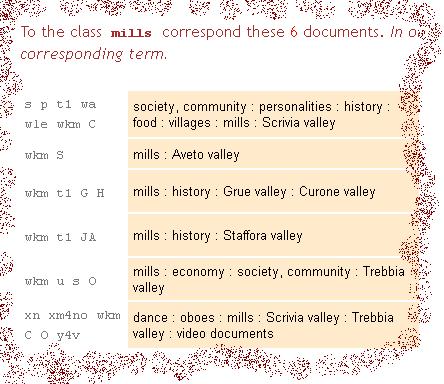 The very first tests were done by Lorena Zuccolo and Claudio Gnoli on the catalogue of a documentation centre (Regione Friuli Venezia Giulia. Laboratorio regionale di Educazione ambientale: LAREA), and more practice was done with the Dandelion Bibliography of Facet Analysis by Hong Mei [Hon05, Gno06b] and a gateway to Internet Resources for Chemical Research edited by Caterina Barazia. Comparative test with a sample of documents classified by both ILC and a traditional disciplinary classification were performed at the Land Ecology Department Library, University of Pavia [Szo16]. Discussion has taken place with experts at the Central National Library in Florence and AIB Research Group on Subject Indexing (Alberto Cheti, Anna Lucarelli, Elisabetta Viti) concerning application of integrative levels in the Nuovo Soggettario.
Philosophical and KO background
"Reality is the basis for the texts of documents; that is what authors try to describe, and what searchers are investigating. Classification, the investigation of structure, is the foundation of all our knowledge, and therefore should be the foundation of all our systems for controlling information." [Fos70a. P 45]
The theory of integrative levels claims that the natural world is organized in a series of levels of increasing complexity: from physical particles and molecules, through biological structures, to the most sophisticated products of human thought. Each level cannot exist without the lower ones (e.g. there are no organisms not formed with atoms), but at the same time it has additional emergent properties not found at the lower levels (e.g. organisms can be said to be alive or dead, while atoms cannot). This view goes beyond the traditional opposition between reductionism and vitalism, both of which have important limitations.
The ideas of integrative levels and emergence can be found in some form in Western philosophy since at least 19th century [Bli92, Gro74], and generally agree with the naturalistic point of view adopted by many modern scientists. However, it was only later that they were formulated in a more explicit way, by philosophers James K Feibleman [Fei54] and Nicolai Hartmann [Har40, Har42]. Hartmann's work is especially relevant for the foundations of ontology, the branch of philosophy dealing with the structure of reality.
The theory of integrative levels was first considered as a basis for knowledge organization during the 1960s by the Classification Research Group (CRG), under influence of biologist Joseph Needham. CRG members (especially Brian Vickery, Barbara Kyle, Douglas Foskett and Derek Austin) reorganized Feibleman's laws of levels, and analyzed their possible application to the construction of a new general classification scheme [Aus69a, CRG69, Fos70a, Gno04b]. They produced a draft scheme using a NATO grant, but did not develop it further.
However, integrative levels have been used as a principle for establishing main class order in other general classification systems, namely CRG's Bliss classification 2nd edition (BC2) and Broad System of Ordering (BSO), and Dahlberg's Information Coding Classification (ICC). Older schemes such as Brown's Subject Classification (SC) and Bliss's Bibliographic Classification (BC1) also have their main class order based on quite the same idea.
Some schemes provide for non-disciplinary classes devoted to single phenomena (e.g., horses instead of zoology or veterinary medicine), and it seems a logical development that these classes would be structured by integrative levels; classes for phenomena and classes for disciplines could be connected through an "accordion device" [Gno05a]. Several authors also wish the development of completely new schemes independent on disciplines, allowing for better multidisciplinary search, as claimed in the León Manifesto.
CRG work leaves us with a precious heritage of advanced techniques (freely faceted classification) that are now being implemented in ILC. The system is developed and managed by an international team led by Claudio Gnoli and including researchers, librarians, computer scientists, and philosophers. Work by both the CRG and the ILC team is documented in many published papers.
Integrative levels classification — ISKO Italia <http://www.iskoi.org/ilc/> : 2004.06.03 - 2023.09.05 -
["Level" instead of "Levels" until 2010.02.03]